

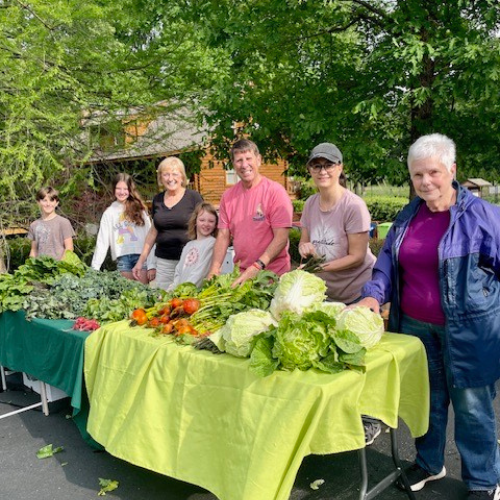
Do you know what Community Supported Agriculture (CSA) is? Did you know we have a ministry at St. Francis that supports local farmers? If not, here is a good way to get great, in-season produce, farmed organically in our local communities. Elizabeth Kearse is the ministry contact for the farm-to-church CSA that supports local BIPOC farmers who use sustainable and/or organic farming methods. Elizabeth says, “We are a part of a larger community group called RAFI, the Rural Advancement Federation International. Their initiative, the ‘Farm to Church’ program, supports farmers of color and connects them with churches throughout Wake County. Each church is assigned to a different farmer who then provides the produce for the CSA at the church.”
“Here at St. Francis,” she continues, “we are partnered with Rick Brown from Brown Family Farms. He is a fourth-generation farmer on land where his ancestors were enslaved, and he now owns the land he farms outright. He grows vegetables and other produce, and a large portion of his acreage is dedicated to hemp production.” Industrial hemp is used in the manufacture of textiles. “Patagonia buys hemp from him for their textiles,” she says, “and he also has a relationship with Vans, who buys hemp from him as well.” Rick is dedicated to organic and sustainable production. “There are no pesticides, and no herbicides,” says Elizabeth.
With the CSA at St. Francis, you purchase a ‘share’ of the produce grown and harvested. “We operate in the spring, the summer, and the fall, and each season is eight weeks long,” explains Elizabeth. “You come on Saturdays to the church to pick up your share of produce, and you get either a half share or a full share. Usually by Thursday of the week, I’ll know what he’ll be delivering, but a lot of this stuff they pull up Friday afternoon or Saturday morning,” emphasizing how fresh the food is! “You’re getting local food, organic food, and you’re supporting your local farmer.” She also notes that you can donate a share. “Whatever produce that we have left over at the end of the pickup, or any donated shares, all get donated out to Catholic Parish Outreach. Even if you’re out of town one weekend and can’t pick up your share, you can donate it. So nothing goes to waste; it will feed your neighbors in need.” In addition to produce, the CSA Ministry supports Lakay Farm in Wake Forest, a local poultry farmer who raises pasture-raised chickens. You can get poultry and eggs at the CSA pickup on Saturdays from Lakay.
Part of the fellowship of the ministry is learning from each other. We share a variety of recipes and preparation methods. “I share that information with the group, especially if it’s something new and different,” says Elizabeth. “Because you’re eating what’s in season, and what’s in season is not what you see at the grocery store all the time, it’s really encouraging people to eat with the seasons. When you eat this way, you’re helping heal the earth because, with their methods, they’re restoring the soil. You’re getting more nutrient-dense foods and caring for your body.”
That ‘Care for Creation’ aspect is not the only Catholic Social Teaching this ministry supports. “You’re caring for your brothers and sisters who might not have enough food on their plate, too, when we donate hundreds of pounds of food in a season,” adds Elizabeth. “Also, the social inequities faced by farmers of color, especially involving the land that’s been taken from them, or how it’s been made very difficult for them to keep that land. We are trying to lift up the people who have not always been cared for, but who have dignity as people and dignity through their work.”
“Every week,” she says, “I feel like you’re meeting new people, and also reconnecting with some of the people that you know who pick up on Saturdays. It’s fun because it’s like a social hour with the people that volunteer to help hand out shares, and there’s a feeling of community in providing food for others, especially really healthy food.” To find out more, contact Elizabeth at eskearse@gmail.com