



In the Gospel of Matthew, chapter 19:13-14, Jesus admonishes his disciples: ‘The children were brought to him that he might lay his hands on them and pray. The disciples rebuked them, but Jesus said, “Let the children come to me, and do not prevent them; for the kingdom of heaven belongs to such as these.”’ Certainly, the fact that we have a robust faith formation program, The Franciscan School, and the St. Francis Preschool at St. Francis speaks to our parish’s continuing dedication to the youngest members of our faith.
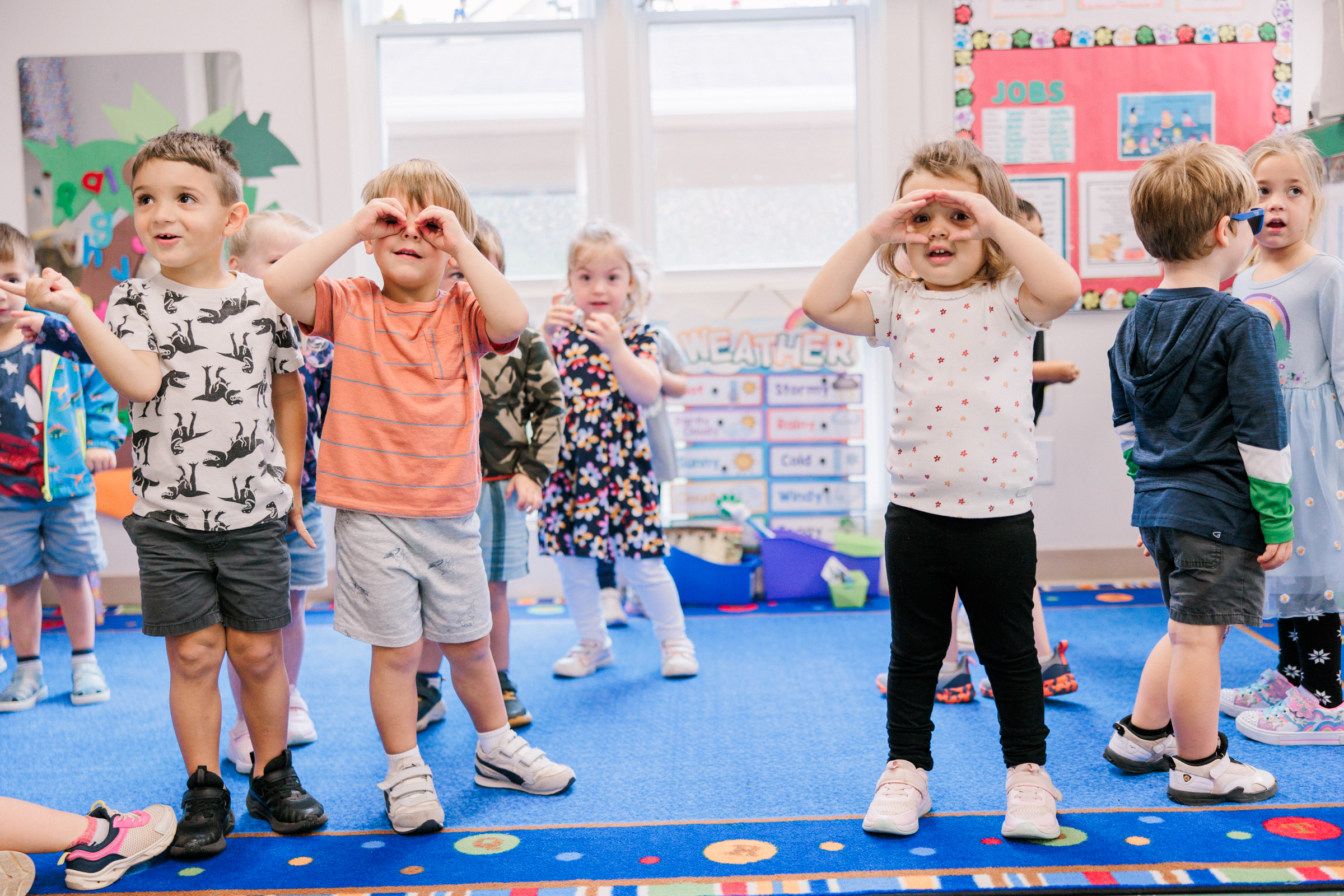
Specifically, at St. Francis Preschool, the Catholic faith is incorporated in all they do. As Director Heidi Hobler says, “The basics of the Catholic Faith are woven throughout our days at preschool. We are continually reiterating, highlighting, and expanding upon three main ideas: God made us, He loves us, and He wants us to love others.” With this knowledge, and at their age level, teachers then build on these main ideas. For example, the teachers introduce and practice prayers with their students to start and end the day, as well as before meals. “While our older students work towards learning traditional Catholic prayers such as the ‘Our Father’ and ‘Bless Us O Lord’, our younger students often use hand motions, rhymes, and song to express their prayers,” adds Heidi.
This focus on the faith is not unique to St. Francis, and the Diocese has standards for introducing children to the faith.”When preparing to introduce any part of our Catholic Faith, the teachers can look to the Diocesan Early Childhood Standards, which outline goals and objectives for each age level,” Heidi points out. “Our lessons reflect the Diocesan standards and the spiritual concepts, and the teachers draw on their professional experience and knowledge of their class to design and implement the standards for the spiritual area we are discussing.” The liturgical calendar, as well as the school calendar, allows teachers to capture the essence of major Catholic celebrations, such as Advent, Christmas, Lent, and Easter. “Since preschoolers learn best through play, lessons about these special times during the church year unfold through art, song, pretend play, and in-house field trips to the church, narthex, memorial garden, or chapel,” adds Heidi. As an example, she explains how, to celebrate Jesus’ birth, some classes had a ‘birthday party’ for the Christ Child and were asked to think of a gift that they would bring Him. “Since many of them have knowledge of babies and what they need,” she says, “this was not a difficult question for most of them.”
Another example recently occurred with the start of the Lenten season. “Our older children attended a special preschool Ash Wednesday service in the chapel with Jim Wahl,” Heidi said. “It was a ‘downsized’ version of the services held throughout the day in the church, yet it included a Bible story, song, and distribution of ashes.” They are always cognizant of the limitations of the age groups of their students and ‘size the celebrations’ to reflect their understanding and attention levels. As an example, she says, “Because our 2-year-olds might not all yet have the ability to sit and attend a service like this, ashes were brought to them where they were, even if they were out on the playground.” The message to them was that the ashes, in the form of a cross on their foreheads, were a sign of God’s love, and we celebrate the extent of His love at Easter.
Heidi explained how they use the Lenten season to emphasize not ‘giving up’ but ‘adding’ to their lives: “Some of the classes made prayer pots out of clay that they took home to hopefully fill with the ‘good deeds’ that they complete during Lent to reflect how God wants us always to try to be kind and compassionate.” They also find active ways to age-appropriately engage the students in learning about the major events of Lent. Heidi mentions that, “When preparing to celebrate Palm Sunday, many of our classes will learn about Jesus coming into town on a donkey by having a class parade to the church with palms. They might even have the children pretend that they, too, are riding a donkey as Jesus did!”
In conjunction with these lessons, the preschool also strives to emphasize the parish’s mission to care for others and the world around us by working with the ministries at St. Francis. They do this by doing school-wide service projects throughout the year. These projects are designed to work within a young child’s knowledge base. For example, they make hot cocoa kits for the church’s Brown Bag Ministry, which serves low-income seniors. “Most of our children are familiar with hot cocoa and how much of a treat it is,” points out Heidi, “and many of them also have grandparents who might have difficulty doing things for themselves. These ideas are already in a child’s wheelhouse from personal experience, and they provide a concrete understanding for our children of ways to take care of others.”
The idea is to help students bring their faith into their daily lives, not just on Sundays. “We teach the students that God always wants to talk to us, whether we are in church, at home, at school, or outside at play,” Heidi says. Classes also read and discuss Bible stories and have Bible lessons daily using materials designed for these little learners. Throughout a typical day, multiple opportunities present themselves for teachers to emphasize key ideas. One hallmark of preschool, for example, is the practice of their social-emotional skills. Some of these include learning to work with others, helping and caring for others, respecting others’ differences, and listening to others. Many of these “soft skills” go hand-in-hand with the lessons of our faith, in which our call is to take care of others. This environment allows for ‘real-life reinforcement’ of the lessons of our faith.
“I think that one of the biggest benefits that we have within our school environment is seeing how completely and uninhibited a child generally is in expressing the faith lessons they have been taught,” Heidi emphasizes. “They do not shy away from participating in faith activities, and bring their whole heart and selves into their day.” When she sees a child quietly fold their hands in prayer without being prompted, share a prayer intention, on their own, for a sick classmate, or bring a card to school for a friend that they worked hard on at home, those are moments that she says are a witness to the benefits of our faith lessons. “When a parent tells you they were inspired to undertake the Order of Christian Initiation of Adults (OCIA) by their child, who came home and shared a prayer before dinner, that is when we also witness the benefits of what happens inside and outside of preschool,” she says.