





“Francis changed the church by refusing to give in to the prevalent view of the time that all creation was riddled with sin and ugliness. He helped remind the Church of God’s goodness inherent in all creation; it is this goodness that is more powerful and always victorious over sin, darkness, and death. The Church still needs to remember this powerful goodness, and, hopefully, the continued presence of the Franciscan movement in the world today can help to cultivate it.”
These words, spoken by an expert on Francis, are certainly true, but what do we really know about our patron saint as we commemorate the 800th anniversary of his Transitus? We have moved through many important 800th anniversaries of Francis over the last several years. From a Franciscan Friar website: “The great Franciscan Jubilee journey from 2023 to 2026 retraced the final years of St. Francis: from the approval of the Rule and the Christmas at Greccio in 1223, to the gift of the Stigmata in 1224, and the 1225 composition of the Canticle of the Creatures. The Transitus marks the end of this journey.”
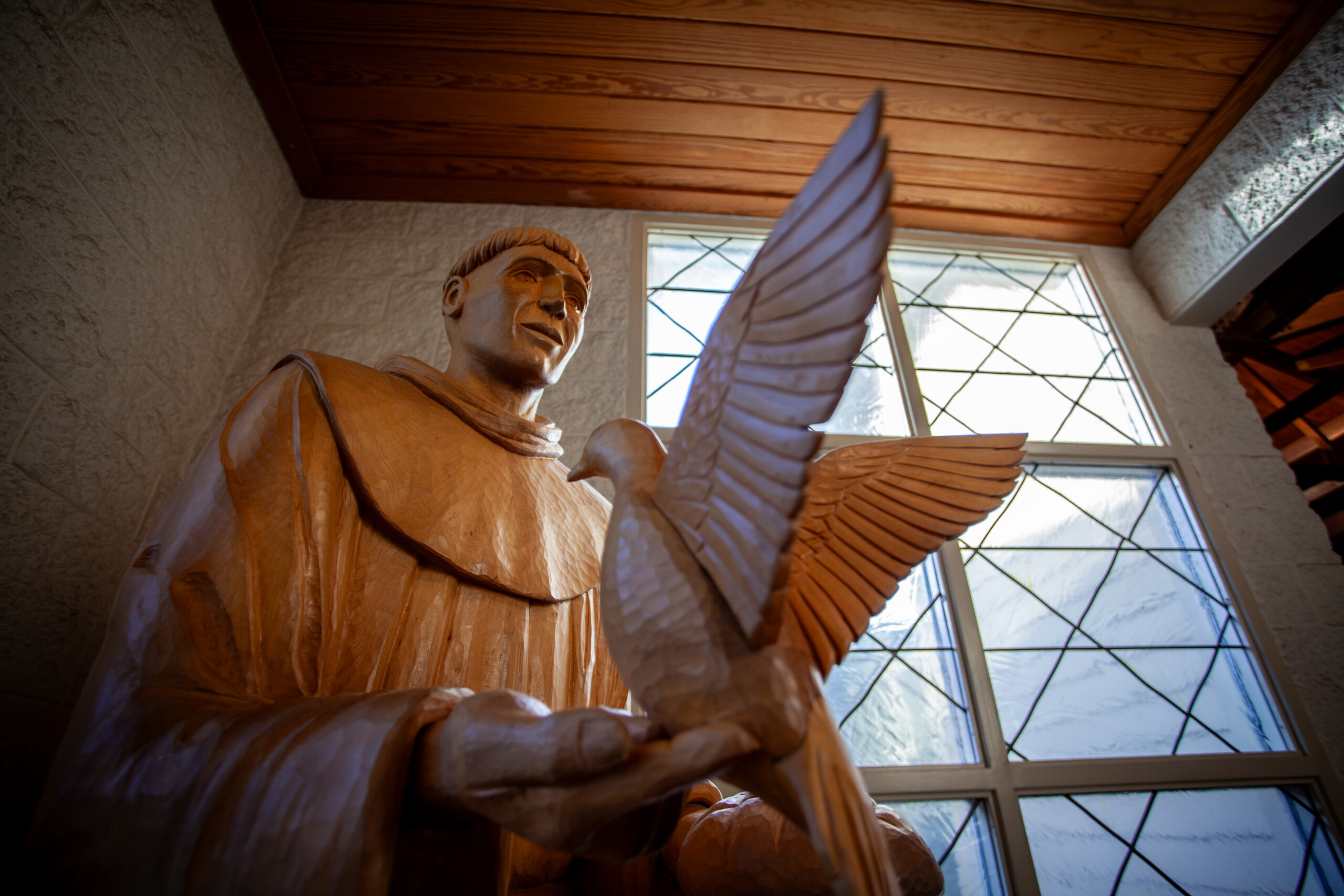
As parishioners, we may be familiar with these events, as well as his embrace of the leper, his ill-fated adventures as a knight, his break with family, and the conversation with the sultan. Representations of all of these, and more, adorn the walls of our parish, but why has Francis persisted as a force within the Church?
The early life of any medieval saint is hard to chronicle with certainty. Perhaps we can say that he was shaped in some way by the Christianity of his time, but like most of those who grow up in a faith life without much substance, he may have given only surface attention to it. It was the trauma of war and imprisonment that brought about a conversion that ran deeper than most believers of the time. The conversion was deeper in the sense that it brought about a relationship with Christ and God that would have been difficult to imagine among the common believers at the time.
What this relationship revealed to Francis was that to grow as believers, we need to embrace the care and concern for each other because that is what God desires us to do. This care for each other, a caring for God’s Creation, and the revolutionary thought that we aren’t living fully in a world of sin and damnation rocked the Church. Church leadership, in the person of Innocent III, realized its responsibility to make this “care for the people of God” happen as well. Francis seems to have made a great contribution and played an important role in influencing Innocent III that living as the gospel asks us to live is possible, even if the pope did not embrace it as fully as Francis did.
Perhaps this is why Francis continues to have an enduring impact in the Church, and especially among people, both believers and non-believers alike, for the last 800 years. In our confusing world, people want to know what is really “true”, but so many people and groups claim truth. With Francis, truth is not a philosophical or political construct; it is a way of living one’s life that dares to proclaim that God’s goodness, love, and care, as demonstrated by all people with a Franciscan heart, will be victorious in the end. Even when things are darkest, and selfishness and violence seem to have the upper hand, do not despair and do not give up, because God will overcome these things. We see this in Francis’ later life when he gave up governing the order and, by and large, the community he founded forgot and marginalized him.
It was during this period that the Order moved away from the principles of simplicity and fraternity that made Francis’ movement so extraordinary. Still, he did not despair, and even in this neglected situation he found himself experiencing the Stigmata and composed the “Canticle of the Creatures.” He did not give up his great belief that God would bring good out of this, or any, difficult situation. He lived his life trying always to discern what God’s plan for him was, and it was this discernment that sustained him. He even had to take some steps backward at times because he realized he was going in the wrong direction, but God never failed him even when everyone else may have. His challenge to us is to discern what God needs us to do and to have the courage to do it.
This fundamental message is why Francis’ legacy endures. His movement to equalize some of the hierarchical and clerical tendencies within the Church, while always remaining faithful to the Church and its teaching, also subtly advanced some of the gospel’s more ‘radical’ principles without church authorities realizing it because it was a grassroots movement. It was he who gave credibility to the potential of all the baptized, not just clerics, to proclaim God and God’s word to others. Francis’ creative imagination was at work in the establishment of a community of brothers, not priests or deacons.
This imaginative dynamic was furthered by the creation of a branch of the movement for men and women who did not have to live a vowed life as Francis and his brothers did. This movement is known today as the Secular Franciscan Order, which then, as today, has as much of a standing within the greater Franciscan Order as the men’s branch and the branch for religious sisters, the Poor Clares. Together these various branches of Saint Francis’ dream became a revolutionary movement.
Francis was disarming and charismatic, but he was no fool, and perhaps more intelligent than many who called themselves scholars in his time; he used his talents to give praise to God, to creation, to human beings, and to the beauty of God found in all things. He changed the Church by refusing to give in to a view that all creation was ridden with sin and ugliness, and helped to remind the Church of God’s goodness inherent in all creation, which is more powerful and always victorious over sin, darkness, and death. The Church still needs to remember and to enact his imaginative perspective, and hopefully the continued presence of the Franciscan movement in the world today can cultivate it.
As we commemorate all that St. Francis has done to lead the Church into a future we all now take for granted, and given the challenges that still exist in the world, it is good to remember the prayer that Pope Leo XIV offered, beseeching Saint Francis of Assisi to continue to instill in all of us perfect joy and harmony:
“Saint Francis, our brother, you who eight hundred years ago went to meet Sister Death as a man at peace, intercede for us before the Lord.
You recognized true peace in the Crucifix of San Damiano; teach us to seek in Him the source of all reconciliation that breaks down every wall.
You who, unarmed, crossed the lines of war and misunderstanding, give us the courage to build bridges where the world raises boundaries.
In this time afflicted by conflict and division, intercede for us so that we may become peacemakers: unarmed and disarming witnesses of the peace that comes from Christ.
Amen”