





The family is considered to be the foundation of the Church. As the United States Conference of Catholic Bishops (USCBB) website has said since 2021, “The Holy Father, Pope Francis, reminded us that, ‘The joy of love experienced by families is also the joy of the Church.’ As the bishops of the United States, we renew our commitment to serve all married couples and families in our midst with a renewed pastoral attentiveness. It is our hope that the principles presented here will encourage effective efforts toward a renewal of evangelization in our country. The Church’s ministry to and with families is of paramount importance, for ‘as the family goes, so goes the nation, and so goes the whole world in which we live.’ Entrusting this work, therefore, to the intercession of the Holy Family of Nazareth, it is our prayer that families across our country will be renewed, fortified, and inspired by God’s plan of love and life.“
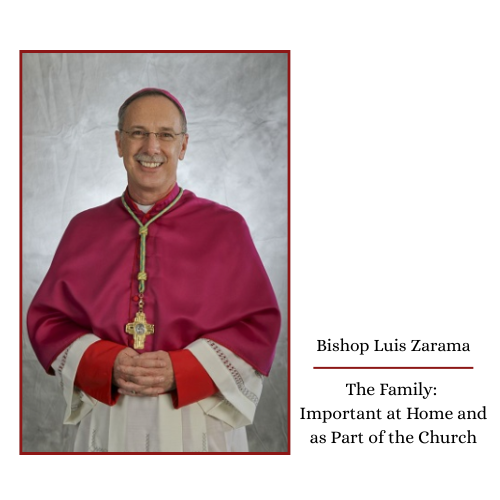
Bishop Luis Rafael Zarama believes deeply in this focus on the family. He fondly recalls trips he took with his own family as a child: “I remember when we traveled as a family; in those times, there was no air conditioning in the car. We were packed, the six of us, driving in the car. There was no radio in the car, and the entertainment for us was my mom and my dad singing. We were happy because usually they repeated the songs, and we would say, ‘Oh, again with that.’ Having that memory of my parents doing that and helping us to sing with them is a beautiful memory.”
Remembering the time spent in the simple joys of being together is an essential memory for Bishop Luis, but he fears we have lost some of that simplicity due to technology. “By removing the cellular phone from their faces,” he says, “the great gift is that you can see who is in front of you; it’s another person like you. When people are constantly on their cell phones, with it in their faces and interacting online, it takes away life.” He isn’t the only one who sees cell phones and technology as having a detrimental effect on families and simple interpersonal interactions. Still, he sees it as a specific challenge for Catholic families, given the foundational nature of families to the Church. “How can families work together to remove distractions and give time for them to be present to each other? Because of cell phones, they can be sitting at the same table, but they don’t interact because each one is busy with their own cellular world, in their own conversations with people not even present with them. They are missing the beautiful gift of seeing each other.” Bishop Luis encourages families to set aside time to simply be together and enjoy each other’s company.
He also wants to encourage parents to embrace their traditional roles. “Another important thing is that the parents assume the role to be the parent, a father, and a mother. Today, it is the tendency for parents to want to be more like friends with their kids, and I think that is the wrong approach.” He tells parents, “The kids have plenty of friends. They can choose friends and dismiss others, but parents are different.” He stresses, “They have only one father and one mother. If parents are afraid to assume the roles of father and mother, they are not serving their children.” In the Church, we all have vocations. Bishop Luis says, ”Being a mother and being a father is a vocation that we cannot deny. Their calling is to have the beautiful role of being a father and a mother. The ones who are there to become role models for the kids.” The kids need to see a mom and a dad, not ‘my cool adult friend.’ He encourages parents to let their children go outside and be with their friends, which is perfectly fine. “However,” he says, “having a father and a mother who challenge us is okay, too. That is the parents’ role, and that is what is needed.”
The vocation to be a father and a mother is essential to the Church, as important as the other vocations. “Remember,” says Bishop Luis, “that God is the father; a father who creates, who gives life. How can we reflect that? How can the parents reflect that in their daily lives?” He wants us to remember that the church is a family, with much diversity, and represents what we find in each of our families. “You know, each kid brings their gifts and their challenges to the family. It is the same way for all of us in the Church family.” It is the interactions and the time together that are important and that build both the Church and the family. “Being together means you need to make time to be together, interact, and see each other. Have fun sitting down to a meal, enjoy listening to stories about the day, and appreciate life. Being part of a family means finding a place where you and others feel valued and important, which is why all families need to make time to be together; to know that you are important to someone. The family is the first place we find the people and the place for that lesson.”
As part of the Church family, we all play our parts, and that is what makes the family stronger. The same is true for our own families at home. Embrace each other by providing time, attention, and appreciation for the joy found in one another, just as we do in the Church family, and see how that time and attention build the bonds strongly. God formed all families and modeled his Church after his most important creation. Entwine yourself in both.