



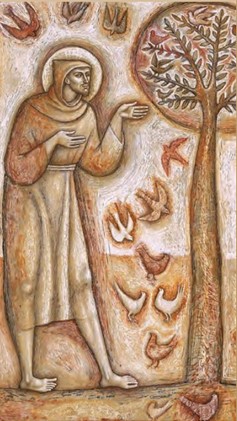

We continue to celebrate the 800th anniversary of many aspects of the life of Saint Francis here at the parish. Articles on when Francis received the wounds of Christ, or stigmata, and his creation of the tradition of having a creche at Christmas to celebrate Christ’s birth, lead to this penultimate discussion of the ‘Canticle of the Creatures.’’ We are recognizing these events leading up to the larger recognition, next year in 2026, of the anniversary of the death of Francis.
What was the Canticle of the Creatures, and why is it important? “The Canticle,” according to our own Father Jim Sabak, “while used a lot in the pursuit of eco-friendly activities, is more than an ecological statement; it speaks of forgiveness and death!” He points out, “These are the only times that he mentions humanity, and it is again a part of Francis’ conception of relationship. Francis held that there is a cosmic connection between all earthly and heavenly creation because the cosmos is filled with the presence of God. Creation reveals to us the presence of God when his creation is engaged with and used in appropriate and proper ways.”
It is through creation, the Brother Sun and Sister Moon that Francis sings of, that reveals Francis’s theology of referring to animals as brothers and sisters to Mankind. He rejected material accumulation and sensual comforts in favor of what he called ‘Lady Poverty’. He viewed humankind as part of creation and not separate or above it. “One of the things a believer in the world should always acknowledge is that we are a part of something greater than ourselves,” says Father Jim. “Francis came to this very profound understanding, which then causes our petty jealousies and affronts to matter little.” Father Jim asks, “If we orient ourselves in this way, what kind of world could be created?”
The Canticle of the Creatures, also known as Canticle of the Sun and Laudes Creaturarum (Praise of the Creatures), was composed by Saint Francis as a religious song. As to the canticle’s historical relevance, “It is believed to be the first work of literature written in the Italian language with a known author,” according to Wikipedia. Jim Wahl, Director of Liturgical Music at St. Francis, tells us, “The way that we typically enter the Canticle of Creation is through its musical roots. ‘All Creatures of our God and King’ and ‘Canticle of the Sun’ are two examples that most current Catholics know well.” As to the importance of this work, Jim Wahl agrees with Father Jim: “I would add that the Franciscan view of creation and the world allows us to move forward as a ‘third way’ between the divisions that are so apparent in our world, where people are either believers in God or science.” Francis points us to the realization that humankind is part of creation, too.
The realization that God and science are not ‘walled off’ and separate from each other is difficult for many. “I believe that the wisdom of Francis still is capable of impacting the world,” says Father Jim, “but the challenge is whether we can be open to the message and allow it to impact us?” Father Jim emphasizes that Francis’ life was based on relationality, on the importance of building bonds between human beings and of reconciling those bonds when arrogance or ignorance put stress upon them. “His words are a challenge to the ego and selfishness that too many times guide human activity in the world today, and these actions actually stand in contradiction of what it means to be human.”
“I think that because relationship was the foundation of his ministry,” points out Father Jim, “he is therefore more approachable than other saints; because he wrestled with the values and goals of the world, there is a genuineness to the message he preached. If people are looking for what brings us together rather than what tears us apart, then Francis becomes a guiding light in this pursuit.”
“However,” he adds, “I think it is important not to mythologize him. He dealt with real-world issues, even though he was a dreamer, and knew disappointment and sometimes the misdirection of his ideal.” Francis often felt the friars could not be as poor as he wanted, for instance, but he never rejected them or left the order to start something else. “He accepted the frailty of humanity,” says Father Jim, “and yet saw that God was active, especially there. This viewpoint makes him even more approachable and attractive to those who are looking, perhaps, for authenticity in living out the gospel or living faith.”
As we remember all that Francis gave the world in the past 800 years, and appreciate his theology, we must not forget how believers viewed God in Francis’s time on Earth. “Too many times,” says Father Jim, “we approach God with a formality born of a misinterpretation of God; we view him as a monarch or dictator. This formality was never Francis’s approach, and, in the time in which he lived, there was much more freedom and fluidity to approach God and Christ as friend and as brother.” He says, “Christ presented Francis with an invitation to live a life with meaning, and Francis accepts, and his life is changed forever.” “If our approach to God is one of undue formality, we can never appreciate or understand this trajectory to change our lives,” Father Jim reminds us. “We need to reclaim this insight to help us live fully alive and fully aware of the presence of God around us, which is experienced most profoundly in the presence of God in creation and in each other.”